Special Collections
Foreword
It is with great pride that we present here Part I of William MacKay’s Collection of Early Medieval English Coins. William will be well known to many readers given the conspicuous role he has played in British numismatics over the last two decades, through his authoring and co-authoring a series of important papers on Anglo-Saxon numismatics, his employment within Spink’s auction team, his serving as Director of the British Numismatic Society and, most recently, his work in preparing several volumes of the SCBI series dedicated to the collection of Scottish coins formed by the late Lord Stewartby. The coins offered within this catalogue were acquired across six decades; they have been selected in order to a give as complete a cross section of the Anglo-Saxon period as possible, whilst also reflecting the vendor’s personal specialisation.
No study of early medieval England can be considered comprehensive without thorough consideration of Anglo-Saxon money. Many of the processes which culminated in the unification of England can be traced back to the arrival of St Augustine and his missionaries in 597. A reassertion of Christianity brought with it a renewed emphasis on writing, learning, and codified legal systems. This, in turn, inspired a gradual redistribution of political power; away from numerous small territorial lordships towards a few dominant kingdoms. These developments helped to crystallise Bede’s ‘English People’ and it is to our great benefit that the social, political and religious changes of the seventh to eleventh centuries are consistently reflected in the coinage of the period.
The earliest of the English coins, the extremely rare gold Shillings, are represented here by two specimens (1001-2). The iconography of these coins draws heavily on late Antique prototypes, and demonstrate the Anglo-Saxon preference for expressions of Romanitas. The former piece is one of the few seventh century coins which carries an intelligible legend, in the form of a bilingual Latin and Runic inscription. In the late seventh century we see a gradual transition from gold to silver and beginning of the Sceatta coinage. The designs employed here are remarkably varied, reflecting adherence to the new Christian dogma (lot 1006), the influence of pagan precedents (lot 1009) and again, a deep reverence for the Roman past (lot 1004).
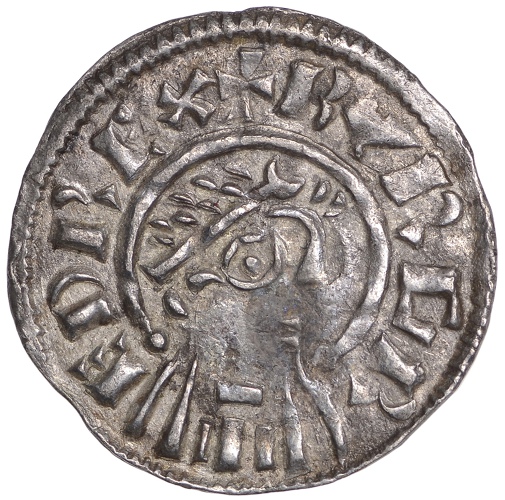
A series of reforms during the mid eighth century, introduced during the time of the Mercian king Offa (lot 1018), drastically changed the appearance the English currency. From this point onwards coinage was explicitly a royal instrument, and new designs incorporate the names of kings as standard. Now, the numismatic evidence blossoms as a historical source, complementing and challenging the contemporary written records. Indeed, it is because of the surviving coins that we understand that Burgred of Mercia was not the weak, ineffectual ruler made out by the Chronicler, but rather a king of consequence, who exerted great influence over Wessex monetarily (lots 1021-1035); that Æthelberht and his Archbishop attempted to restore standards in Wessex during the years Viking induced crisis (lot 1017); and that Alfred the Great held London throughout the early 880s (lot 1046).
It was under Æthelstan of Wessex, grandson of Alfred, that the whole of England once again fell under the control of a single leader; an arrangement not seen since the height of the Roman Empire. The significance of this was not lost on Æthelstan, who celebrated his position as Rex Totius Britanniæ on both charters and coins (lot 1056). The expansion of West-Saxon control also served to increase the number of boroughs striking money for the king. Æthelstan’s attempts to organise his new network of mint-places involved the first widespread use of mint-signatures on England’s coinage. This system, which retained considerable regional variation, was not wholly successful and following Æthelstan’s death geographical anonymity once again became the norm for England’s coinage (lots 1057-1063).
The vision for a system of centrally administered provincial mints was finally realised under Eadgar and his successors (lots 1064 onwards). From 973 onwards all coins carried a royal portrait on their obverse and both the moneyer’s name and a mint signature on their reverse. Starting in Æthelred II’s reign the appearance of England’s money was changed at regular intervals, with the preceding coinage recalled from circulation and re-struck, resulting in a period of varied and stimulating numismatic material. The collection ends, appropriately, with an attractive penny of Harold II (lot 1104).
On the following pages we have provided a table giving metallurgical data for the coins contained within this part of the collection. The analysis was performed in-house using a Niton XL2 XRF analyser device. These readings represent a surface analysis; in the case of the two Shillings experience tells us that the true fineness of the coins is likely to a little lower than that given here. Readers wanting useful points of comparison might consult the introductory chapter by Gareth Williams and Duncan Hook in SCBI 63, Table V in Volume I of Rory Naismith’s The Coinage of Southern England and more generally the various papers published by Metcalf and Northover.
Share This Page